Showing posts with label island books. Show all posts

Wednesday, 27 August 2008

Sea Change


Occasionally one plucks a book from the TBR mountain, seemingly at random, which turns out to be Just Exactly Right.

For me, Sea Change: The Summer Voyage from East to West Scotland of the "Anassa", by Mairi Hedderwick - which has been sitting on the TBR pile for literally years, since I acquired it when last in the Hebrides - proved, last week, Precisely Perfect in Every Way.

Regular readers may in fact remember that I was resolved to make a start on it way back in May, when I mused about my family's love of the author's delightful Katie Morag stories . But I was sidetracked by other books and it became submerged. My 'summer reading' has ranged from sporadic to non-existent - just too much else going on. But I suddenly remembered it and it seemed like a good choice of beach reading in Mersea Week, when boats are - even more than usual - the island's defining theme.

Sea Change opens with a couple of quotes, the second of which is from Better Small Boat Sailing by John Fisher (1955): 'Two kinds of women take to boats - those who like it and those who fear to be left behind.'

Born in Gourock, Mairi Hedderwick took a job, at the age of 17, as a mother's help on the Island of Coll in the Hebrides and there began a life-long love affair with islands and small communities bounded by sea. After attending the Edinburgh College of Art, Mairi married and had two children. In 1962 she decided to opt out of the rat race, and the family moved to Coll where they lived in a house three miles from the nearest neighbour with no road or electricity, with the only water available from a well. The Isle of Struay, setting for the Katie Morag stories, is loosely based on Coll. Though some of her grandchildren live there still, on turning 60, Mairi decided it was time to stop being 'Grannie Island' and to move on to becoming 'Granma Mainland'. Sea Change is the story of the journey she decided to undertake to mark this great turning point in her life:

'I had decided to leave the island, and live on the mainland. But before the transition, I had also decided, the water in between would have to be propitiated - slowly, lingeringly, and bravely. It would be a fitting farewell to the seascape I have loved and known so well for so long - but always with my feet firmly planted on the rock and sand of the island.

I am in awe of the sea; I am also frightened by it. "But you lived on an island!" Ah, but that is the excitement of it! To be surrounded by such an element makes for a feeling of security - in storm or calm. To look out of a salt-encrusted window at a Force 10 in the bay, kettle bouncing and blistering on the hotplate, is quite the most secure of feelings. Equally, to hear the scritch-scratching of lazy sun-soaked wavelets on the shore, through wide-open windows in the long, light nights of June, that also confirms safe encirclement.'

'Safe encirclement' - the true words of a landlubbing islander - just like me!

Hedderwick and her unnamed 'Captain', an old family friend, purchase a rare classic cruiser, Anassa, built in Rangoon in 1954, and embark on a six-week voyage from Lossiemouth on the east coast of Scotland, down the Caledonian Canal and out to sea, through the Sound of Mull and northwards around the western coast as far as Loch Nevis.

'What better way to say farewell to my island home than sail the waters between island and mainland and explore the fingers of fjords that indent the west coast of Scotland? Be an adventurer in the last true wilderness with only the silver-pathed reflection of the moon and the stars to guide the way.'

The pair's roles are clearly defined. The (very experienced) Captain is firmly in charge of navigation and sailing, while Hedderwick is cook, bottlewasher, mistress of home comforts aboard their cramped temporary home and slightly reluctant and nervous 'crew'. And, of course, records the whole journey in ink and watercolour, as well as words. And what words! She writes so directly, so honestly and so darned well. We are party to her deepest lifelong fears of the sea, of seaweed, and of hideous, nameless sea-monsters; her persistent seasickness; her sense, always, that she is out of her element on a boat and that everything that goes wrong is entirely her fault. But her dogged persistence and determination that she will do this are hugely endearing and we will her to overcome her demons and succeed.


There are setbacks right from the start. They run aground in the Moray Firth, caught on an uncharted shingle bar at the mouth of the River Ness, brought down by storm floods:

'There is another split second of disorientation, followed by total incomprehension and panic. I scramble up the slope of the deck to the port gunwale, as evil swirling river water rushes over the starboard gunwale. Immediately the Captain is getting me into my survival suit and lifejacket. I'm incapable of any action save clinging to the rail and looking skywards. The inflatable dinghy takes for ever to unrope from the deck. The Captain's foot inflates it a crazy speed, at a crazy angle. I am waiting for Anassa to crack asunder or keel right over. Can I swim for the far shore, where people are already stopping their cars and staring? I will not swim over the yellow fingers of seaweed that dervish-dance along the submerged port side. How far will I have to jump to avoid them . . .?

As the seconds of panic ease into minutes of possibly reassuring stability, only because I move not a muscle and shallow breath, the Captain assesses our situation. "We'll just have to wait for the tide to come back in and lift her off. No problem. Just patience." . . . He is laughing. Would you believe it? As I relax my grip on the stays . . . my knees trembling with loosening tension, I know it has all been my fault. Guilt floods in with the enervation. What damage has been done to Anassa's keel and hull? My fault, my fault . . . I was at the helm . . . Day one of the Voyage and I am quite ready to pack it all in.'

There are many other moments of adversity - some nautical, some practical, some concerning tensions in the relationship between the frequently tetchy Captain and his often frightened and frustrated crewmember. Yet somehow, despite it all, they find a shared humour and slog on, according to their original plans as far as possible.


The author's acute ear and eye for character, so evident in the Katie Morag stories, make for some delicious, spot-on, descriptions of people and boats encountered en route. And her response to the eternally magnificent West Highland scenery is unfailingly fresh, never descending into guidebook cliche, for which one can only give her extra, grateful, points.

This is a spiritual journey and a personal challenge greater than it might, at first, appear. Yet despite the deeply serious, life-changing intent and effect of the voyage, Hedderwick is adorably self-effacing throughout. Just when we think she's really getting to grips with life afloat, she'll make some desperate, yearning reference to bubble baths or luxury loos. And near the end of the return trip, having triumphantly achieved her 'foody' objective of eating only freshly gathered sustenance (no tins or packets on board - lots of fresh-caught mackerel) for six weeks, she is suddenly overcome by a dispiriting suspicion that the Captain is in fact a secret Pot Noodle eater.

Set in some of the British coastline dearest to my own heart, and written in the slightly bewildered voice of the non-boaty person rather belatedly afloat, Sea Change spoke very directly to me and I found it sheer unputdownable delight from start to finish.

Fold-out reproductions of Hedderwick's lovely watercolour seascapes, and dozens of line sketches of life on board Anassa make the book visually interesting, too, but in my view the words alone amply convey the essential truths and beauties of the author's remarkable Sea Change.

Sunday, 15 June 2008

The Wild Island


The Wild Island by Antonia Fraser only cost me 20p. And it was tosh. But it was very entertaining tosh. Set in a remote Highland glen, the Wild Island in question - Eilean Fas - sits in the middle of a fast-flowing river. There's a spooky ancient house, there are slippery rocks, swirling mists and a rickety bridge. There are menacing Scottish nationalists, dope-smoking orphaned princesses (this is the 1970s), claimants to the throne of Scotland, festering family grievances, disputed ancestry, castles, stags' heads on every wall, faithful family servants, a number of mysterious deaths, and lots and lots of men in (and, on occasion, out of) kilts. Jemima Shore investigates the whole caboodle and finally discovers what lies beneath the history, the murders . . . and the kilts! As an amusing alternative to channel-hopping on a rare evening off with a glass of wine, it was worth every penny.

Saturday, 7 June 2008

£1.40's worth


. . . of books from one of my favourite charity shops this morning.

I already have this edition of The Well of Loneliness, but it's a Green Virago, so I couldn't possibly not scoop it up, could I?
And I've never read any of Antonia Fraser's Jemima Shore stories, and probably never would have done, but this one is set on a Scottish island (oh, and it was only 20p!) and so I thought it would make a good addition to my self-imposed Island Fiction Reading Challenge, which started here and developed here here (and my thanks to Petrona for putting out a call for suggestions).

I'm currently re-reading some George MacKay Brown short stories, The Sun's Net, which are set on Orkney. All further suggestions most welcome - and it's British islands I'm particularly interested in (so no need to mention Ms Hislop, thanks!).

The jacket blurb for Wild Island says this is:

'. . . an adventure far removed from Jemima's visions of heather-covered hills, crystal-clear streams, romantic men in kilts, fairy-tale castles . . . Instead she is plunged into the strange world of the aristocratic Beauregard family with its tensions, its jealousies and its violence. The setting is the Wild Island itself, sometimes enchanting but too often frighteningly remote.'

Hmm, well it's a shame about the lack of romantic men in kilts, but it still sounds like a good cosy one for a rainy evening with a glass of this!

Thursday, 29 May 2008

A favourite island artist


Seeing some lovely photos of Loch Linnhe (which lies between Glencoe and Fort William in western Scotland) while surfing around some photography sites has inspired me to extract another book from the TBR Mountain (the height of which is reaching Highland proportions itself). And this is what I have chosen: Sea Change: The Summer Voyage from East to West Scotland of the "Anassa", by Mairi Hedderwick.


I bought this three years ago while saying on Mull but have never got round to reading it. At the same time, I bought Eye on the Hebrides - a personal record in words and sketches of Mairi Hedderwick's six-month solitary journey of the Western Isles of Scotland - and Highland Journey: Sketching Tour of Scotland Retracing the Footsteps of Victorian Artist John T. Reid , both of which I did read at the time.


Sea Change slipped through the net, but I'm really looking forward to snuggling down with it. The back-cover blurb is promising:

'What possessed Mairi Hedderwick to undertake a six-week voyage with the Captain down the Caledonian Canal and out to sea in a small, antiquated sailing boat? . . . The names of the places she visited ring out like an old Gaelic song: Lock Linnhe, Loch Etive, Lochs Ailort and Moidart,Loch Nevis, Loch na Droma Buidhe, Loch a'Choire and Loch Leven. And finally, mysteriously, to the "island", her old home, her pilgrimage complete and the purpose of the journey fulfilled.'


There are hand-drawn maps and pull-out watercolour panoramas. I'll post a review here as soon as I've finished it. It seems that it's out of print, but there is a plentiful supply of new and used copies on offer via Amazon and Abe Books.


Mairi Hedderwick is one of my family's top favourite artist-writers. It all started when SD# was a toddler and I used to take her down to Colchester library every week, and it was there that we first discovered Katie Morag.


Katie Morag McColl lives on the tiny fictional Hebridean island of Struay , where her mother is the postmistress. Her father runs the island shop (and in later stories the island Bistro), and her 'Grannie Island' has a croft at the other side of the bay. Grannie Island drives a tractor and wears wellies and doesn't suffer fools gladly - especially Katie's other grandmother, Grandma Mainland, a city-dwelling confection of frothy pink clothes, feathery hats, wafting perfume and bouffant silvery hair.

Struay is populated by a delightful collection of characters of all ages, and Katie's adventures are homely but significant for small children, and filled with love, laughter and the sound of the sea. When a new baby arrives in the family, Katie gets in a grump and hurls her beloved teddy in the tea - but luckily, he survives a few submarine adventures of his own and the tide washes him up on the beach. Katie gets into scrapes with her visiting Boy Cousins, shampoos a sheep ready for the Island Show, makes a point of visiting her neighbours on Baking Day, and takes a starring role in Grandma Mainland's wedding to a local fisherman (spoiler alert!!).


The stories are amusing and realistic, and the illustrations are sheer delight. Hedderwick performs a wonderfully reassuring service to harassed, imperfect mothers who juggle work and family, by portraying a domestic life of general untidiness and sometimes utter chaos. No picture of Katie's bed is complete without a discarded apple core beneath it, and Mrs McColl struggles with breastfeeding and teething babies and burns the cakes on the day an important guest is coming for tea.


If you're new to Katie Morag, I recommend a quick look at her very own web page and suggest that the best book to start with is The Big Katie Morag Storybook, which collects together a selection of stories and poems.

Here's a quick biog of Hedderwick which I've lifted from her publisher's site:

Mairi was born in Gourock, Scotland in 1939. At the age of 17 she took a job as a mother's help on the Island of Coll in the Hebrides and there began a life-long love affair with islands and small communities bounded by sea. After attending the Edinburgh College of Art, Mairi married and had two children, Mark and Tamara. In 1962 she decided to opt out of the rat race, and the family moved to Coll where they lived in a house three miles from the nearest neighbour with no road or electricity, with the only water available from a well. The Isle of Struay, setting for Katie Morag, is loosely based on Coll, and some of the content reflects Mairi's own experiences: Katie's toys are those of her own children, Granny Island's Rayburn stove was Mairi's own, and Mairi admits she has thrown her own teddy bear into the sea - twice!. As an adult! As well as writing and illustrating children's books Mairi writes and illustrates travel books for adults. She spend a lot of time visiting schools and is always accompanied by Katie Morag's teddy that travels with her in a black bag.


And she featured in Scotland on Sunday's 'Welcome to My World' series last weekend, which you can read here here. I certainly like the sound of her 'perfect weekend'!


You can download and print this Katie Morag bookplate absolutely free, as many times as you wish, from Anne Fine's wonderful My Home Library website (there are loads of other bookplates here and printable bookmarks here - altogether a bit of a must for parents and teachers, this one).


And finally, while this Hebridean Desk Address Book sits on my desk (where else?), I do rather hanker after some other spin-offs in the Hedderwick range. There's a Hebridean Desk Diary, a Hebridean Visitors Book and a Hebridean Birthday Book.


Monday, 26 May 2008

Raven Black


One of the books I read while confined to barracks by the appalling weather this weekend was Raven Black by Ann Cleeves. I'd read Cleeves's Hidden Depths earlier this year, and reviewed it here. As soon as I'd finished that one, I popped Raven Black in my Amazon shopping trolley, intrigued by the idea of a quartet of novels set on an island - in this case Shetland.
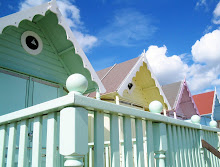
Before getting round to opening Raven Black, however, another island-based crime novel pushed its way forcefully to the top of the pile - Losing You by Nicci French, which is set on an island heavily based on Mersea, where I live. Thinking about Losing You (which I reviewed here) gave rise to some more general musings about the advantages of setting a crime novel on an island.

Clearly, an island gives a writer small, complex community, in which many of the inhabitants will be interrelated; where resentments can fester - perhaps for generations; where secrets have to be kept more deeply hidden than in a less close-knit society; and from which quick escape can be physically difficult or impossible.

In today's age of instant mass communication, a remote island gives a perfect opportunity for recapturing realistically some essential elements from the world of 'golden age' detective fiction which would seem impossibly stilted on the modern mainland.

Islands (even not especially remote ones) often suffer from patchy mobile phone signals and restricted Internet access; they are cut off both literally and maybe socially from the rest of the world; roads may be difficult, police numbers low (and officers inexperienced in murder inquiries); there can be a stark distinction - even open hostility - between natives and incomers. All perfect for the the development of plot and a rich cast of interesting characters. And all cleverly exploited by Ann Cleeves in Raven Black, which I thoroughly enjoyed.

I've never visited the Shetland isles - Orkney is as far north in the UK as I've ventured thus far. But Raven Black has certainly inspired me to investigate, and it seems that I'm not the only one. The Shetland tourist industry is delighted by the effect that Cleeves' first two Shetland novels are having (and two more are in the pipeline). You can read about it all on her website.

Raven Black introduces us Inspector Jimmy Perez, an appealing detective who, despite his exotic name, is actually a native of Fair Isle - and thus at once an islander and an outsider (Fair Isle lies midway between Orkney and Shetland).

It's January, and everyone's looking forward to the Up Helly Aa festival. Heavy snow has fallen. A beautiful and enigmatic sixteen-year-old is found dead in a field one bitterly cold morning. Her murder raises memories of the unsolved disappearance, some years before, of a young girl whose body was never found. Could the two crimes be connected?

I'm always overcome with nerves at the prospect of reviewing a crime novel - the risk of inserting accidental spoilers is extreme. So I'll leave it to the experts: there are reviews by Maxine Clarke (aka Petrona) here and by Sunnie Gill here - both on the excellent Euro Crime site.

Coming from outside the ranks of the truly dedicated crime devotees, as I do, unlike Maxine I welcomed all the atmosphere and didn't find the centre of the novel flagged at all. Raven Black was planned as the first in a quartet of Shetland-based novels, so it's hardly surprising that Cleeves takes her time with some detailed scene-setting. And although it's part of the British Isles, Shetland will be unfamiliar territory for the vast majority of readers in the UK, let alone those from the rest of the world, so I appreciated the way that Cleeves interweaves and underpins her plot with a substantial sense of place.

Suffice to say, this would seem a very worthy winner of the Duncan Lawrie Dagger and I'm very much looking forward to reading the next book in the series, White Nights.

Sunday, 4 May 2008

Losing You (and the Mersea connection)


I found Losing You quite literally unputdownable, demanding to be read at every possible moment through a single day, eg while waiting for the kettle to boil, cleaning my teeth, or stirring the baked beans (there was nothing else on offer in the food line until I'd finished it!)

It's Nina Landry's 40th birthday, and she's packing ready to catch a plane to Florida with her teenage daughter Charlie and 11-year-old son Jackson, together with her new boyfriend, who's meeting them at the airport. As the morning ticks by, she becomes increasingly anxious about Charlie, who hasn't come home from a sleepover at a friend's house the night before. Soon it is clear - Charlie is missing. The police are called and Nina herself begins a frantic search for her daughter. Has she run away or has she been abducted? Is she alive or dead? Written in real time, the sustained tension becomes almost unbearable as the minutes become hours - and yet, just as in real life, there's no escape. Nina has to confront this head-on, and everything else in her life is gradually peeled away until she (and we) are conscious only of one thing: the pared-down essence of a mother's desperate love for her child, as every parent's worst nightmare unfolds.

Every time I write a review of a crime novel I seem to sprinkle it with disclaimers (as I did earlier today) along the lines of 'I'm not really a fan of crime fiction as a genre - I just enjoy good writing'. Perhaps I should stop saying this. On the other hand, it is true that a crime novel needs to recommend itself to me on a deeper level than its clever plotting. I'm a bit dim when it comes to twisty plots - I don't wrestle with them intellectually, I just go along for the ride. Losing You is vastly more than a plot, however: it's a passionate, sensitive and wholly convincing exploration of an ordinary woman's extraordinary (but at the same time very ordinary - most of us, thank heavens, don't have our love tested to these limits) love for her child.

I can't better Maxine's excellent review of this book for Eurocrime , with which I wholeheartedly concur in every respect - except one. She writes:

'The claustrophobic setting, on the remote (and, from what I can tell, fictional) Sandling Island in the east of England, adds to the atmosphere.'

Sandling Island is, in fact, very heavily based on Mersea Island - the muddy isle from whence these Musings ooze. It was discovering this in the authors' post about Losing You on the Moments in Crime blog - and realising that they had such a keen appreciation of the island’s landscape and ambience - that prompted me to buy the book instantly.

Of course, the strict geography of the island has been adapted to fit the requirements of the plot, but many authentic elements both contain and drive the action and the atmosphere is spot-on. The fact that the tide often covers the causeway, cutting the island off from the mainland is critical, and descriptions of the coastline, the miles of deserted muddy dikes, the wintery chill and greyness, take on an increasing menace despite not being over-dramatised.

'Here, on Sandling Island, it was all horizon: the level land, the mudflats, the miles of marshes, the saltings, the grey, wrinkled sea. Now it was mid-morning and from where I stood - facing west towards the mainland - I could see only the glistening mudflats with their narrow, oozing ditches of water where waders were walking with high-stepping delicate legs and giving mournful cries, as if they'd lost something. It was low tide. Little boats tethered to their unnecessary buoys tipped at a steep angle to show their blistered, slimy hulls; their halliards chinked and chimed in the wind.'

So while I defy any reader not to identify with Nina as the time in Losing You runs out, being the fortysomething mother of a teenage daughter and an 11-year-old son, living on Mersea Island with a black labrador, I’m aware that my capacity for empathy with the central character was pretty heavily weighted. The spooky coincidences of these similarities undoubtedly made the unfolding events of the plot doubly agonising and horrifying. I was pretty much a nervous wreck by the time I reached the final pages.

But I'm OK again now.

Postscript: I've handed Losing You to my own island teenage daughter to read and will be fascinated to hear what she makes of it, and whether she considers the portrayal of Charlie and her friends to be as authentic as I found them from my mumsy perspective. Maybe I'll get her to do a guest post here so we can all find out what she thought. However, I very much doubt that she could argue with one of the best descriptions of a teenage girl's bedroom I've ever read:

'Clothes lay on the carpet where they had been dropped. There were a belt, an empty violin case, a fake tigerskin rug, pencils, a broken ruler, scissors, a pair of flip-flops, CDs with no cases, CD cases with no CDs, a string bag, a couple of teen magazines, a book splayed open, the top half of a pair of pyjamas, a large stuffed green lizard, a couple of small piles of dirty clothes, a broken hairdryer, scattered items of makeup, disparate shoes and three bath towels. Charlie seemed to prefer using a clean towel after each bath or shower, though not to the extent of putting the dirty ones in the washing-basket. Her laptop computer sat on her desk with a tartan pencil case, several notebooks, a pink-capped deodorant, a bottle of Clearasil, a shoebox, a furry cow, various assorted piles of schoolwork and much, much more.'

In an afterword to the novel, Sean French and Nicci Gerrard explain:

'We didn't have to travel very far to research Charlie's room, which in its epic untidiness is a combination of two of our three daughters' rooms, except not quite as bad.'

. . . . lol, rofl

Thursday, 27 December 2007

Where was I . . .?

Well, as previously intimated, my Christmas ended up a bit of a rub-out all round.

On Sunday, after a final (surprisingly leisurely) stroll round Sainsbury’s, spent the evening in the company of friends - and friends and neighbours of friends – which was all very jolly and congenial. My attempts to cauterise the onrush of attacking viruses by the judicious application of alcohol were unsuccessful from a medical perspective, but released my usually (very) well hidden reserves of wit, charm and erudition right up to the Unfortunate Incident with the Wine and the Natural Fibre Floorcovering some five hours later. After which (and following some strenuous blotting) a hasty retreat was effected.

(I have today been emailed with reassuring photographic evidence that the floorcovering – and thus, more crucially, the highly valued friendship – seems to have survived more or less intact, thanks largely to my serendipitous preference, that evening, for pink over red wine.)

Christmas Eve I don’t really remember, apart from a lot of belated wrestling with paper and sellotape. On Christmas Day – having 'achieved' lunch (very slowly, while everyone else was off out singing carols) – I retreated to the sofa, upon which I reclined, as elegantly as possible under the circumstances, for most of the rest of the ‘festivities’. Thankfully, I had received a copy of Alan Bennett’s The Uncommon Reader , which was just the thing to read between snoozes. I had never been in any doubt that I would enjoy this delightful little flight of fancy and I wasn’t disappointed. It was every bit as amusing, droll and gently satirical as I’d anticipated.


I have read some whingeing comments by some of the more serious book-bloggers complaining that it is some kind of cynical rip-off, an overpriced little outing on the bandwaggon by its author and publishers alike. I beg to disagree quite noisily. Plenty of Alan Bennett’s previous shorter works – including Father! Father! Burning Bright and The Clothes They Stood Up In have been published as modestly priced paperbacks and even given away free with newspapers, I seem to remember. From time to time, however, Christmas being pre-eminently one of those times, there’s nothing more cosy and satisfying than holding in one hand a nicely produced, small hardback book which one can read and enjoy without very much effort while clutching a life-enhancing/sustaining mug of tea or a glass of mulled wine (for example), in the other hand. The Twelve Days of Christmas [correspondence] was one such. The Uncommon Reader is another.

To complain about its price per page of text, or to compare it somehow with the cost or importance of a weighty, award-winning biography, for example, is to take it entirely out of context. The publishers got it just right, in my view, so enjoy it for what it is and stop moaning, is my seasonal message!

Having polished that one off and had another snooze or two, I started on Margery Allingham’s Mystery Mile . I hadn’t read any Allingham before, but this one had been on my list because it is set on a small island which purports to be in Suffolk but which was, in fact, based on Mersea, where Allingham had holidayed as a child. The island has shrunk to a fraction of its true size and population (even in the 1930s), and the Strood becomes the ‘Stroud’, but there’s a pub called the Dog and Pheasant and the vivid descriptions of the marshes, the mud and the estuarine tides will be easily recognisable to anyone who knows Mersea.

It was a good one to read while under the weather, though I confess that some of the urge to turn pages very quickly owed more to my frustration with the endless, camp, bletherings of the aptly named hero, Albert Campion, than it did to the compelling interest of the plot. It was rather like watching a pantomime, I thought – with too much magic and disappearances in puffs of smoke (or Mersea mist, indeed) – for my liking. Now you see him, now you don’t, but look – he’s right behind you! It seemed very much a 1930s period piece and I don’t feel terribly inclined to pursue the Campion series further. There’s an interesting page about the Mersea connection on the Margery Allingham Society website, though, and I’m quite interested in laying my hands on a copy of her first published novel, Blackkerchief Dick (1923), which is set entirely on Mersea, but it seems never to have been reprinted and the original editions are rare and command prices unfeasible for the merely curious.

The remainder of my recumbent day was spent enjoying the fabulous Royal Ballet production Prokofiev’s/Kenneth Macmillan’s Romeo and Juliet, with Carlos Acosta and Tamara Rojo. Just sublime. This has long been my favourite ballet of all time, and Prokofiev’s score some of my favourite music full stop (in fact, strike all other ballets from the repertoire and just leave this one – it has everything one could possibly need). The music is replaying in my head even now. There are some clips of Rojo and Acosta rehearsing and talking about the production here , here and here.


The very silly but good fun (if you like that kind of thing) Dr Who Christmas Special was followed by the girls going off to watch yet more of the endless Strictly Come Dancing spin-offs (I’m all Strictlied-out and won’t be able to bear another dose for at least six months), while I dozed with the menfolk in front of a DVD of The Battle of Britain, which I hadn’t watched for many years.

Always intriguing to observe that, although authenticity was (to my untrained eye, at least) achieved in so many ways, the women’s makeup and hairstyles were anachronistically 1960s. Was this a refusal on the part of actresses (Susannah York in particular) to contemplate assuming the appearance of their mothers’ generation? Did nobody notice that short, feathered hair and pale lipstick just didn’t achieve the wartime ‘look’? Or was it simply considered an unimportant detail for some reason? This is by no means a unique phenomenon in 60s films, but it jars even more distressingly against the WRAF uniforms than it does in other 60s 'costume dramas'. Perhaps it is only with hindsight that we can see these things clearly.

On the home front, not only is the Christmas cake still uncut . . . it hasn't even been decorated! It's merely a huge white blob of naked icing. I'm just about to do something spontaneous and creative with some gold paper and a red candle. But whether anyone will actually attack it with a sharp knife today is anyone's guess - we're all still stuffed after a late lunch of spaghetti carbonara plus stir-fried sprouts with Black Farmer hickory smoked bacon.


I love sprouts!