Showing posts sorted by relevance for query sea change. Sort by date Show all posts

Wednesday, 27 August 2008

Sea Change


Occasionally one plucks a book from the TBR mountain, seemingly at random, which turns out to be Just Exactly Right.

For me, Sea Change: The Summer Voyage from East to West Scotland of the "Anassa", by Mairi Hedderwick - which has been sitting on the TBR pile for literally years, since I acquired it when last in the Hebrides - proved, last week, Precisely Perfect in Every Way.

Regular readers may in fact remember that I was resolved to make a start on it way back in May, when I mused about my family's love of the author's delightful Katie Morag stories . But I was sidetracked by other books and it became submerged. My 'summer reading' has ranged from sporadic to non-existent - just too much else going on. But I suddenly remembered it and it seemed like a good choice of beach reading in Mersea Week, when boats are - even more than usual - the island's defining theme.

Sea Change opens with a couple of quotes, the second of which is from Better Small Boat Sailing by John Fisher (1955): 'Two kinds of women take to boats - those who like it and those who fear to be left behind.'

Born in Gourock, Mairi Hedderwick took a job, at the age of 17, as a mother's help on the Island of Coll in the Hebrides and there began a life-long love affair with islands and small communities bounded by sea. After attending the Edinburgh College of Art, Mairi married and had two children. In 1962 she decided to opt out of the rat race, and the family moved to Coll where they lived in a house three miles from the nearest neighbour with no road or electricity, with the only water available from a well. The Isle of Struay, setting for the Katie Morag stories, is loosely based on Coll. Though some of her grandchildren live there still, on turning 60, Mairi decided it was time to stop being 'Grannie Island' and to move on to becoming 'Granma Mainland'. Sea Change is the story of the journey she decided to undertake to mark this great turning point in her life:

'I had decided to leave the island, and live on the mainland. But before the transition, I had also decided, the water in between would have to be propitiated - slowly, lingeringly, and bravely. It would be a fitting farewell to the seascape I have loved and known so well for so long - but always with my feet firmly planted on the rock and sand of the island.

I am in awe of the sea; I am also frightened by it. "But you lived on an island!" Ah, but that is the excitement of it! To be surrounded by such an element makes for a feeling of security - in storm or calm. To look out of a salt-encrusted window at a Force 10 in the bay, kettle bouncing and blistering on the hotplate, is quite the most secure of feelings. Equally, to hear the scritch-scratching of lazy sun-soaked wavelets on the shore, through wide-open windows in the long, light nights of June, that also confirms safe encirclement.'

'Safe encirclement' - the true words of a landlubbing islander - just like me!

Hedderwick and her unnamed 'Captain', an old family friend, purchase a rare classic cruiser, Anassa, built in Rangoon in 1954, and embark on a six-week voyage from Lossiemouth on the east coast of Scotland, down the Caledonian Canal and out to sea, through the Sound of Mull and northwards around the western coast as far as Loch Nevis.

'What better way to say farewell to my island home than sail the waters between island and mainland and explore the fingers of fjords that indent the west coast of Scotland? Be an adventurer in the last true wilderness with only the silver-pathed reflection of the moon and the stars to guide the way.'

The pair's roles are clearly defined. The (very experienced) Captain is firmly in charge of navigation and sailing, while Hedderwick is cook, bottlewasher, mistress of home comforts aboard their cramped temporary home and slightly reluctant and nervous 'crew'. And, of course, records the whole journey in ink and watercolour, as well as words. And what words! She writes so directly, so honestly and so darned well. We are party to her deepest lifelong fears of the sea, of seaweed, and of hideous, nameless sea-monsters; her persistent seasickness; her sense, always, that she is out of her element on a boat and that everything that goes wrong is entirely her fault. But her dogged persistence and determination that she will do this are hugely endearing and we will her to overcome her demons and succeed.


There are setbacks right from the start. They run aground in the Moray Firth, caught on an uncharted shingle bar at the mouth of the River Ness, brought down by storm floods:

'There is another split second of disorientation, followed by total incomprehension and panic. I scramble up the slope of the deck to the port gunwale, as evil swirling river water rushes over the starboard gunwale. Immediately the Captain is getting me into my survival suit and lifejacket. I'm incapable of any action save clinging to the rail and looking skywards. The inflatable dinghy takes for ever to unrope from the deck. The Captain's foot inflates it a crazy speed, at a crazy angle. I am waiting for Anassa to crack asunder or keel right over. Can I swim for the far shore, where people are already stopping their cars and staring? I will not swim over the yellow fingers of seaweed that dervish-dance along the submerged port side. How far will I have to jump to avoid them . . .?

As the seconds of panic ease into minutes of possibly reassuring stability, only because I move not a muscle and shallow breath, the Captain assesses our situation. "We'll just have to wait for the tide to come back in and lift her off. No problem. Just patience." . . . He is laughing. Would you believe it? As I relax my grip on the stays . . . my knees trembling with loosening tension, I know it has all been my fault. Guilt floods in with the enervation. What damage has been done to Anassa's keel and hull? My fault, my fault . . . I was at the helm . . . Day one of the Voyage and I am quite ready to pack it all in.'

There are many other moments of adversity - some nautical, some practical, some concerning tensions in the relationship between the frequently tetchy Captain and his often frightened and frustrated crewmember. Yet somehow, despite it all, they find a shared humour and slog on, according to their original plans as far as possible.


The author's acute ear and eye for character, so evident in the Katie Morag stories, make for some delicious, spot-on, descriptions of people and boats encountered en route. And her response to the eternally magnificent West Highland scenery is unfailingly fresh, never descending into guidebook cliche, for which one can only give her extra, grateful, points.

This is a spiritual journey and a personal challenge greater than it might, at first, appear. Yet despite the deeply serious, life-changing intent and effect of the voyage, Hedderwick is adorably self-effacing throughout. Just when we think she's really getting to grips with life afloat, she'll make some desperate, yearning reference to bubble baths or luxury loos. And near the end of the return trip, having triumphantly achieved her 'foody' objective of eating only freshly gathered sustenance (no tins or packets on board - lots of fresh-caught mackerel) for six weeks, she is suddenly overcome by a dispiriting suspicion that the Captain is in fact a secret Pot Noodle eater.

Set in some of the British coastline dearest to my own heart, and written in the slightly bewildered voice of the non-boaty person rather belatedly afloat, Sea Change spoke very directly to me and I found it sheer unputdownable delight from start to finish.

Fold-out reproductions of Hedderwick's lovely watercolour seascapes, and dozens of line sketches of life on board Anassa make the book visually interesting, too, but in my view the words alone amply convey the essential truths and beauties of the author's remarkable Sea Change.

Thursday, 29 May 2008

A favourite island artist


Seeing some lovely photos of Loch Linnhe (which lies between Glencoe and Fort William in western Scotland) while surfing around some photography sites has inspired me to extract another book from the TBR Mountain (the height of which is reaching Highland proportions itself). And this is what I have chosen: Sea Change: The Summer Voyage from East to West Scotland of the "Anassa", by Mairi Hedderwick.


I bought this three years ago while saying on Mull but have never got round to reading it. At the same time, I bought Eye on the Hebrides - a personal record in words and sketches of Mairi Hedderwick's six-month solitary journey of the Western Isles of Scotland - and Highland Journey: Sketching Tour of Scotland Retracing the Footsteps of Victorian Artist John T. Reid , both of which I did read at the time.


Sea Change slipped through the net, but I'm really looking forward to snuggling down with it. The back-cover blurb is promising:

'What possessed Mairi Hedderwick to undertake a six-week voyage with the Captain down the Caledonian Canal and out to sea in a small, antiquated sailing boat? . . . The names of the places she visited ring out like an old Gaelic song: Lock Linnhe, Loch Etive, Lochs Ailort and Moidart,Loch Nevis, Loch na Droma Buidhe, Loch a'Choire and Loch Leven. And finally, mysteriously, to the "island", her old home, her pilgrimage complete and the purpose of the journey fulfilled.'


There are hand-drawn maps and pull-out watercolour panoramas. I'll post a review here as soon as I've finished it. It seems that it's out of print, but there is a plentiful supply of new and used copies on offer via Amazon and Abe Books.


Mairi Hedderwick is one of my family's top favourite artist-writers. It all started when SD# was a toddler and I used to take her down to Colchester library every week, and it was there that we first discovered Katie Morag.


Katie Morag McColl lives on the tiny fictional Hebridean island of Struay , where her mother is the postmistress. Her father runs the island shop (and in later stories the island Bistro), and her 'Grannie Island' has a croft at the other side of the bay. Grannie Island drives a tractor and wears wellies and doesn't suffer fools gladly - especially Katie's other grandmother, Grandma Mainland, a city-dwelling confection of frothy pink clothes, feathery hats, wafting perfume and bouffant silvery hair.

Struay is populated by a delightful collection of characters of all ages, and Katie's adventures are homely but significant for small children, and filled with love, laughter and the sound of the sea. When a new baby arrives in the family, Katie gets in a grump and hurls her beloved teddy in the tea - but luckily, he survives a few submarine adventures of his own and the tide washes him up on the beach. Katie gets into scrapes with her visiting Boy Cousins, shampoos a sheep ready for the Island Show, makes a point of visiting her neighbours on Baking Day, and takes a starring role in Grandma Mainland's wedding to a local fisherman (spoiler alert!!).


The stories are amusing and realistic, and the illustrations are sheer delight. Hedderwick performs a wonderfully reassuring service to harassed, imperfect mothers who juggle work and family, by portraying a domestic life of general untidiness and sometimes utter chaos. No picture of Katie's bed is complete without a discarded apple core beneath it, and Mrs McColl struggles with breastfeeding and teething babies and burns the cakes on the day an important guest is coming for tea.


If you're new to Katie Morag, I recommend a quick look at her very own web page and suggest that the best book to start with is The Big Katie Morag Storybook, which collects together a selection of stories and poems.

Here's a quick biog of Hedderwick which I've lifted from her publisher's site:

Mairi was born in Gourock, Scotland in 1939. At the age of 17 she took a job as a mother's help on the Island of Coll in the Hebrides and there began a life-long love affair with islands and small communities bounded by sea. After attending the Edinburgh College of Art, Mairi married and had two children, Mark and Tamara. In 1962 she decided to opt out of the rat race, and the family moved to Coll where they lived in a house three miles from the nearest neighbour with no road or electricity, with the only water available from a well. The Isle of Struay, setting for Katie Morag, is loosely based on Coll, and some of the content reflects Mairi's own experiences: Katie's toys are those of her own children, Granny Island's Rayburn stove was Mairi's own, and Mairi admits she has thrown her own teddy bear into the sea - twice!. As an adult! As well as writing and illustrating children's books Mairi writes and illustrates travel books for adults. She spend a lot of time visiting schools and is always accompanied by Katie Morag's teddy that travels with her in a black bag.


And she featured in Scotland on Sunday's 'Welcome to My World' series last weekend, which you can read here here. I certainly like the sound of her 'perfect weekend'!


You can download and print this Katie Morag bookplate absolutely free, as many times as you wish, from Anne Fine's wonderful My Home Library website (there are loads of other bookplates here and printable bookmarks here - altogether a bit of a must for parents and teachers, this one).


And finally, while this Hebridean Desk Address Book sits on my desk (where else?), I do rather hanker after some other spin-offs in the Hedderwick range. There's a Hebridean Desk Diary, a Hebridean Visitors Book and a Hebridean Birthday Book.


Thursday, 11 September 2008

Sea Change - the voyage

Addendum to previous post on Sea Change: The Summer Voyage from East to West Scotland of the "Anassa", by Mairi Hedderwick: I completely forgot to include this essential and most attractive map, showing the route taken by Mairi and her Captain (click to enlarge):


I do so love hand-drawn maps.
Off to Scotland again myself soon. Hurrah!

Sunday, 4 July 2010

An island weekend and TBTE

Well, a whole week has gone by (as they frequently do) when I haven't set foot off the island. Not since returning from the most delicious fish and chip supper on the Quay at Maldon last Saturday night. And this is a  huge part of the charm of island living for me - the wonderful self-contained, self-sufficiency of it all.  (OK, admittedly, I sailed across the Blackwater to Bradwell and back yesterday evening, but I don't think that counts. It wasn't by car and I didn't land anywhere!)

I used to refer to my children here as Small Doyles (SDs) 1, 2 and 3. But since numbers 1 and 2 are now no longer smaller than me (in height, if not girth!), I'm going to have to change the terminology. They'll doubtless object to any clever acronyms I might devise, so for now they can simply be O, elder daughter, freshly emerged from the rigours of GCSEs, looking forward to a summer of music festivals, unrestrained Facebook interaction and never having to do another physics or German exam again in her life; H, pining slightly for rugby but rejoicing in his new-found prowess in javelin and triple-jump, living a Swallows and Amazons existence whenever he can, rowing 'Sea Pig' (of which more soon) with his mates around the creeks and tiny islands off Mersea; and IM, uber girly girl, owner and wearer, by default, of my entire collection of high-heeled party shoes (not items of attire I need much, if ever, these days), obsessive hair-stylist and The One With The Performing Gene.

Much of the weekend was taken up by IM's appearance in Mersea Island Youth Player's' ambitious summer production, The Junction, with performances on Friday and Saturday nights. On Friday, O and H accompanied me to the island's theatre at the MICA centre, seated cabaret-style, for an interesting, if sometimes unsettling experience. The gritty urban storyline, devised by some of the older members of the ensemble - and all credit to them for their imagination - was hardly bedtime story fodder for the 8-year-olds (IM, for example) in the cast, in my view, but maybe that's because I'm an Older Mother and not a hip, cool, whereitsat one. But the dancing, costumes, lighting and general spectacle were superb, and the months of rigorous rehearsal were well rewarded. Directed, produced and musically devised by a dedicated team of islanders, all regular performers at The Mersea Session, The Junction was a splendid showcase of young Mersea talent.
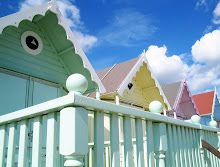

What weather we are having! Today was another cloudless scorcher - but here we have the sea breezes to mitigate the otherwise oppressive heat. I had stacks of work to do, but luckily it was of the scribbling-with-red-pen-on-piles-of-paper kind, so I was able to sit in the garden (paperweights to the fore) for five hours and got through another few chapters before the insistent siren wail of the ironing mound could be borne no longer, and in I came to wrestle with sheets, shirts and skirts, and got a bit steamy.

After hearing IM read another chapter of Matilda aloud, do her guitar practice and finally, after a good deal of prevarication, get into bed, I zipped out for a quick circuit of West Mersea on my lovely 1964 green Triumph Ladies' Bicycle (with basket, naturally) to take the night air and stretch the creaking legs before night fell (the bike being unilluminated, since H 'borrowed' and subsequently broke my last set of lights - and not for the first time, either). Here are the resulting TBTE pics, the first two featuring the historic Oyster Sheds, soon to be demolished, despite vociferous local oposition, to make way for a 'fine dining' restaurant (all highly controversial - more soon) the latter two taken from the Best Office On The Island.


Wednesday, 11 July 2007

A word in my ear

Why do we remember some voices and not others? I mean really hear them – their special timbre and volume and intonation? I realised today that I can hear, in an intensely realised way, the voices of some people I have known, while others have simply disappeared. It is not necessarily anything to do with the closeness of the relationship with the voice concerned, either. I tested this by trying to remember the voices of my late grandmothers. One is still very much there, inside me – I can hear her so clearly that sometimes I hear her voice quite unbidden. The other – and strangely, the grandmother of whom I was most fond - I can ‘remember’, in the sense that I can piece her voice together, recreate it from the things she used to say, from my knowledge of her accent and the pitch of her voice, its similarities to my mother’s voice, but it’s still essentially an external thing. A description, rather than an experience. I thought about school friends with whom I have not spoken for over a quarter of a century. Again, some voices came from inside my head, while others were the auditory equivalent of looking at an old school photo – an assembling exercise from information provided. Not the same at all. Perhaps some voices tune into a unique receptor in the mind’s ear, or set up a special kind of resonance in a particular pinpoint in one’s brain. It has nothing to do with the length of time one knew the voice. Nor the intimacy with which one was involved with the person concerned. It is something else entirely. Perhaps it goes back to the very first moment one heard a particular voice – to the effect that it had, to where, precisely, it first lodged itself in one’s mind. And that is why, while some voices are lost, faded away and gone, other voices – including those I know I will never, ever hear again - seem to exist autonomously, their every nuance so clearly embedded that it’s possible to have a whole conversation with that voice and it will always sound exactly right and true. As if it really has become an intrinsic part of oneself. By such means are some of us rendered, temporarily, immortal. (Gosh, I wonder if anyone can remember my voice - have I got inside anyone's head, or not? - I'll never know.) Is there a religion somewhere that's based on the premise that we live on, briefly, in another person’s ear?? Maybe we have a Jungian 'collective ear' - so that people who 'hear voices', hear real voices - someone else's ancestors, borrowed from some central human pool of remembered sounds. Definitely time for a spot of Googling . . .

Today’s big question: if you drop a large blob of guacamole on your computer keyboard, will the keyboard still work? Answer: yes it will if you remove the guacamole in a particular way. Should you ever find yourself in this position, do please drop me a line and I will explain in easy-to-follow steps. Today’s supplementary question: if, while removing a large blob of guacamole from your keyboard in such as way that the keyboard will subsequently operate perfectly, a small portion accidentally transfers itself to your brand new crinkly silk skirt, will that skirt ever look the same again? Answer: no it will not. Just as well, therefore, that the meeting with daughter’s new head-teacher which had prompted the wearing of said skirt had already taken place a couple of hours earlier.

Whilst attending to my keyboard, I realised that, over the course of the last 18 months or so, I have managed, by my constant toiling thereon, to erase entirely the white letters on the most frequently used keys (it is a black keyboard. I am dead trendy, clearly). What particularly struck me, however, was that I couldn’t for the life of me work out, just by looking at the keyboard, precisely which of the letters had rubbed away. Which letter sits between B and M in the bottom row? No idea at all. I had to type something in order to discover that it was N. This must either be because I have been touch-typing for 25 years and therefore never actually look at the keyboard, or else it is simply that a tough, impenetrable wall (or possibly hedge) has grown up between the two halves of my brain, so that it is no longer possible for the left and right hemispheres to communicate with each other. Is this an age-related phenomenon, I wonder? Or just a personal failing? The latter, I suspect, now I come to think about it. I’ve never been able to play the piano without music. The moment I look down at the keys, I wobble and fall off. I always blamed the way I was taught but now I think it’s just me. And not unconnected with the facts that I am a non-starter at mental arithmetic and can never remember which way to turn the steering wheel when I am parking a car.

So there we have it – from tortilla chip malfunction at lunchtime to a perfect explanation for dented rear wing, in two easy steps. 'There is something wrong with my brain, your honour, I don’t know what comes between K and ; . ' (I just checked and it’s L). Oh and that’s another thing – E, L and N are the rubbed-away letters. Are these the most frequently used in the English language? I shall have to do a bit of research to find out. If not, then it will be something to do with the middle finger of my left hand and the index and ring fingers of my right hand. Perhaps they are stronger and more vigorous and decisive than their digital chums. But, if so, why? The right hand side of the space-bar is worn to a shine (it's a MATT black keyboard - I am THAT trendy), but that is because, when teaching myself to type, I omitted to teach myself to alternate left and right thumbs on the space-bar and therefore only ever use my right thumb for spaces. (My left thumb has been regally held aloft this past quarter century. I really should start thinking of giving it some gainful employment or it might simply fall off, which would be a nuisance.)

All the above is entirely unconnected to the fact that I live on a Muddy Island, so I will end by observing that at 9.30 this evening, the sky was a vibrant turquoise, and it merged, almost imperceptibly (but for the tiniest change of hue if you stared long and hard but not so long and hard that everything went a bit fuzzy) into the dark aquamarine sea. The clouds were a childish, candyfloss pink, their reflection on the wave-tips dramatic shades of lilac. The air hummed with colour and salt and seaweed. The dog swam after an abandoned flip-flop.The tide was up, so the wading birds were silent and the only sound was the tug of the incoming waves on the dried shingle. By 10 o’clock the sky, enchanted by its own reflection, had matched the myriad mauves and purples of the sea. I didn’t take a camera. Seaglass count: 2. Too busy gazing at the sky.

Monday, 13 August 2007

Beachcombing


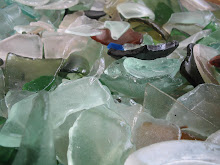
Living by the sea seems to have sparked a compulsion to pick up things noticed on the beach and bring them home. After just nine months here, this is becoming something of a problem – there simply isn’t room for everything. More importantly, it raises the question: why on earth do we do it?

In my son’s case, the answer is fairly straightforward: he brings home driftwood so he can work on it with his tools and turn it into guns. Naturally. He is 10. He has also made model ships and is currently working on a ‘garden sculpture’ as a wedding present for his aunt. My 5-year-old daughter brings home shells and interesting pebbles. They are very pretty, and this is justification enough in her eyes. For my own part, I pick up shards of blue and white patterned china – and, most greedily, seaglass.

But . . . what on earth to do with it all? That is the question. Well, a lot of the pebbles and shells get, sort of . . . erm, ‘recycled’ in the garden, I have to admit. The china shards and the seaglass are piling up on the chest in the hall.


(The hand-coloured etching, '"2 oz Prawns" , incidentally, is by Karen Fardell.)

Some odd bits of wood and rope and oyster shells have ended up on top of a bookcase.


Larger bits have been arranged 'artlessly' in the garden, for that insouciant coastal-living look. So far, so good. But this represents less than a year’s worth of beachcombing. My big worry is . . . what will it be like after half a decade – or longer? At what point, precisely, will one be forced to call a halt to all this scavenging?

One of those lazy/busy weekends – making jam (what a year it is for plums – they are everywhere – people are giving them away, and I never say ‘no’!); walking the dog; an island boot-sale (books, my hopeless weakness – came home with a dozen or more); a quick foray inland to get some bits and pieces from Poplar Nurseries; buying plants from stalls outside people’s houses on the way back (so much more satisfactory – and FAR cheaper! – than visiting a chain garden centre – I picked up some absolutely amazing, and enormous, fuchsias for £3 a go from nice lady in Copford, which would have rendered little change from £20 in Wyevale, and I just know that they’ll be stronger and thrive better than the hot-housed, imported kind).

Lots of garden tidying up; lunch on Sunday at the Courtyard Cafe, at the Mersea Island Vineyard; and rounded off the daylight hours on Sunday with a quick run down to the Hard with son and dog, to burn off all that jam and catch the end of the sunset.


Have just availed myself of this great offer on train tickets to book a short break on the Scottish east coast in October, so I can stay with Rachel Sharp and visit some galleries in Edinburgh and catch the Richard Long exhibition, with any luck. Yippee, can't wait!