Saturday, 10 May 2008

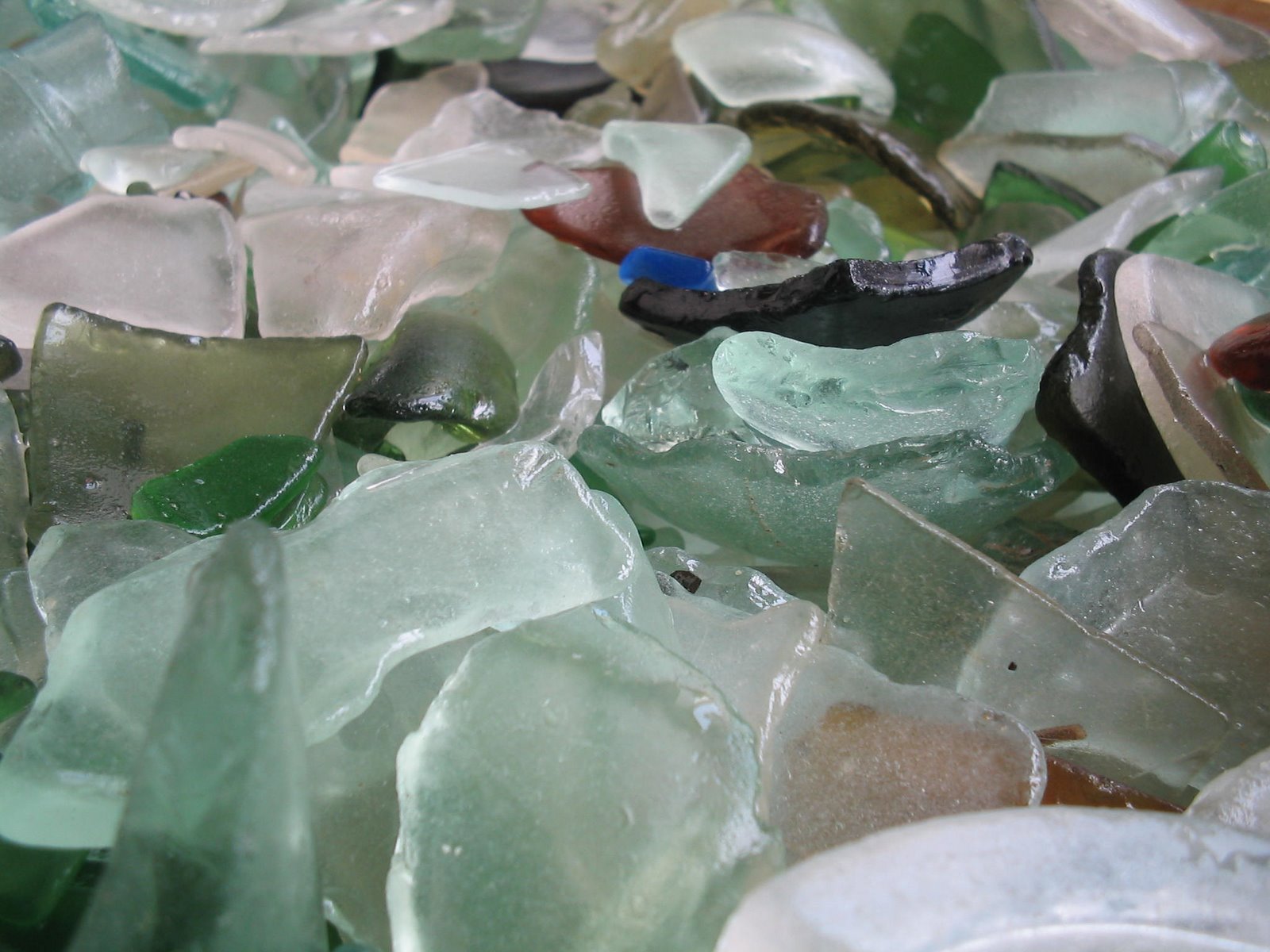
Pure Sea Glass

'There is a splendid irony in collecting sea glass, since this alluring trophy sought after in the shifting sand was once merely sand itself.'

Buying a copy of Pure Sea Glass: Discovering Nature's Vanishing Gems was sheer extravagant self-indulgence on my part, but given that This Sea Glass Thing seems to have taken off in all directions (see, for example, here), I felt in need of a good reference book.


As might be expected, there's absolutely masses of information on the Internet, but as every right-minded bibliophile knows, there's nothing quite like a satisfyingly chunky hardback book, and Pure Sea Glass provides considerably more than mere 'satisfaction' - it's positively droolworthy!

The book distills the considerable knowledge of its author, Richard LaMotte, into easily digestible form. He and his wife, Nancy (who designed the book), have studied some 30,000 pieces of sea glass and one of their chief delights is in identifying the origin of each piece.

'For several thousand years, civilizations have used the same natural ingredients - sand, soda, and lime - to create glass. Leave it to Mother Nature to improve upon something manipulated by man and returned to her care after it has served out temporary needs. The forces of nature not only shape sea glass by abrasive physical conditioning, but contact with aquatic environments creates unique textures that are only poorly imitated by man.'


Pure Sea Glass therefore not only discusses the history of sea glass, the chemical reactions which create its characteristic 'frosting', the best locations for finding it and the comparative rarity of its various colours, but also sets out at some length, and with numerous illustrations, the different types of bottles, tableware and flat glass which have been transformed by the sea. From the shape and colour it is often possible to pinpoint exactly the kind of object or vessel an individual piece of sea glass used to be.


What makes this book particularly special is Celia Parson's astoundingly beautiful photographs. Rarely have I seen such perfectly lit, luminous colour photos, and they have been superbly reproduced by the printers. The close-ups have been thoughtfully executed - while some are heavily styled, others contrive a very natural look. The wide diversity of approaches elevates the book far above a mere visual catalogue (which it could so easily have been). There are also plenty of glorious beachscapes to put the finds in context.

You can catch the flavour of the book on the author/publisher's website, including a synopsis of its contents here. A selection of Celia Parson's photographs can be seen here (go to portfolio and click on sea glass (NB seems to take a while to load but well worth the wait)).

There's an extensive bibliography at the end of the book, together with an equally long list of web addresses for further reference.


Pure Sea Glass has reassured me that my fascination with sea glass is perfectly normal and OK and not simply a deranged form of compulsive scavenging. In fact, it's encouraged me to go out and search with more application because I desperately need some pieces like some of the LaMottes' finest.


'Sea glass is becoming more scarce with every passing day. Quite fortunate are the collectors who still find sea glass in a broad array of colors, since glass vessels produced today are in a far more limited color palette. For those who will follow in our footsteps, the kaleidoscope of glass remnants derived from fragile objects once used by our ancestors will only be thinly scattered along the shore.'


Available in the UK from Amazon and The Book Depository and, in the US, direct from Sea Glass Publishing (from whom you can obtain a signed copy, as well as spin-off posters and note-cards).

The joys of a good hardback


I hardly ever listen to Saturday Live on R4, but I did today and - gosh! - there was Jane, from Books, Mud and Compost, extolling the virtues of the hardback book - from her Folio Society edition of Diary of a Provincial Lady to the wonderful red 1950s/60s hardback versions of Enid Blyton's Famous Five stories.

You can catch the programme again on the R4 website for the next seven days - Jane's about three-quarters of the way through, just after Howard Jacobson's thoughts about the importance of hardback books from an author's point of view (apropos Picador's decision to abandon publishing in hardback).

Friday, 9 May 2008

TBTE

SDs # 2 and 3 and I took our tea down to the beach and ate it sitting on our favourite 'bench' -a huge lump of driftwood which moves around from time to time, whenever there's an exceptionally high tide, affording a slightly different vantage point from which to gaze at the sea or the boatyard while scoffing fish and chips (or, this evening - more virtuously - pasta salad).


Then the children played in the marshes for an hour or so while I read another chunk of A Romance on Three Legs , which is absolutely enthralling. I'll write a review of it very soon.


Ampersands for a Friday Night

Friday night after a particularly beastly working week (which started on bank holiday Monday . . . sigh . . . and much to the detriment of my poor neglected garden).

But the week is over, so get out the corkscrew - it's Party Time for Ampersand lovers!


A large zebra ampersand at this nightclub in Manchester.

Or - very much more my style:


This wonderfully laid-back, bibulous &, which is the logo of this wine merchant. (Many thanks to a regular reader for alerting me to this one.)

Thursday, 8 May 2008

TBTE


. . . found on the beach above the tide-line. Wonder who wrote it. Wonder who they wrote it for. Wonder how long it will last.

Wednesday, 7 May 2008

Bloggers Unite for Human Rights

Bloggers Unite

It's Bloggers Unite For Human Rights day on 15 May.

This year marks the 60th anniversary of the Universal Declaration of Human Rights adopted by the United Nations.

Supported by Amnesty International, Bloggers Unite For Human Rights challenges bloggers everywhere to help elevate human rights by drawing attention to the challenges and successes of human rights issues on 15 May.

You can write about absolutely any human rights topic that you wish, personal or global - or if you're looking for inspiration, there are plenty of resources on the Amnesty International resource section.

It's entirely up to you to decide how you want to join in this inspiring international blog event. Perhaps choose a topic that reflects the emphasis of your blog. What is important is that on one day, thousands - maybe millions - of bloggers will unite and share their unified support of human rights everywhere.

Monday, 5 May 2008

TBTE

Or, strictly speaking, TMTE (the mud this evening).


SDs #1 and 2 on their way back from exploring the wrecked trawler . . .


. . . and desperately trying to retrieve one of SD#2's wellies.


I just stood around taking photos and uttering Predictable Mum remarks, like 'I knew this would happen', and 'I'm going to have to wash that coat, now, aren't I?' and 'no, I am not coming over to help' . . .

Shifting blockages and books

Some more book reviews coming up soon. I seem to have recovered from my recent bout of bookblogger's block. Don't know what brought that on - just one of those things, I suppose.

Meanwhile, here are some great ideas for recycling those books in your collection that you're never going to read again. Of course, most of us take them to our nearest worthy charity shop, or swap them online. But if you're looking for something a little different, you could try these (click on the captions to get the links):


(1) Hanging them from the ceiling.


(2) Gluing them together to form a table.


(3) Turning your favourite cover into a handbag.

(4) Using pages to make magnets.


(5) and just a reminder of my old favourite, the book-book-shelf.


(Many thanks to Barb for pointing me in the direction of the fabulous Black Eiffel.)

Sunday, 4 May 2008

Losing You (and the Mersea connection)


I found Losing You quite literally unputdownable, demanding to be read at every possible moment through a single day, eg while waiting for the kettle to boil, cleaning my teeth, or stirring the baked beans (there was nothing else on offer in the food line until I'd finished it!)

It's Nina Landry's 40th birthday, and she's packing ready to catch a plane to Florida with her teenage daughter Charlie and 11-year-old son Jackson, together with her new boyfriend, who's meeting them at the airport. As the morning ticks by, she becomes increasingly anxious about Charlie, who hasn't come home from a sleepover at a friend's house the night before. Soon it is clear - Charlie is missing. The police are called and Nina herself begins a frantic search for her daughter. Has she run away or has she been abducted? Is she alive or dead? Written in real time, the sustained tension becomes almost unbearable as the minutes become hours - and yet, just as in real life, there's no escape. Nina has to confront this head-on, and everything else in her life is gradually peeled away until she (and we) are conscious only of one thing: the pared-down essence of a mother's desperate love for her child, as every parent's worst nightmare unfolds.

Every time I write a review of a crime novel I seem to sprinkle it with disclaimers (as I did earlier today) along the lines of 'I'm not really a fan of crime fiction as a genre - I just enjoy good writing'. Perhaps I should stop saying this. On the other hand, it is true that a crime novel needs to recommend itself to me on a deeper level than its clever plotting. I'm a bit dim when it comes to twisty plots - I don't wrestle with them intellectually, I just go along for the ride. Losing You is vastly more than a plot, however: it's a passionate, sensitive and wholly convincing exploration of an ordinary woman's extraordinary (but at the same time very ordinary - most of us, thank heavens, don't have our love tested to these limits) love for her child.

I can't better Maxine's excellent review of this book for Eurocrime , with which I wholeheartedly concur in every respect - except one. She writes:

'The claustrophobic setting, on the remote (and, from what I can tell, fictional) Sandling Island in the east of England, adds to the atmosphere.'

Sandling Island is, in fact, very heavily based on Mersea Island - the muddy isle from whence these Musings ooze. It was discovering this in the authors' post about Losing You on the Moments in Crime blog - and realising that they had such a keen appreciation of the island’s landscape and ambience - that prompted me to buy the book instantly.

Of course, the strict geography of the island has been adapted to fit the requirements of the plot, but many authentic elements both contain and drive the action and the atmosphere is spot-on. The fact that the tide often covers the causeway, cutting the island off from the mainland is critical, and descriptions of the coastline, the miles of deserted muddy dikes, the wintery chill and greyness, take on an increasing menace despite not being over-dramatised.

'Here, on Sandling Island, it was all horizon: the level land, the mudflats, the miles of marshes, the saltings, the grey, wrinkled sea. Now it was mid-morning and from where I stood - facing west towards the mainland - I could see only the glistening mudflats with their narrow, oozing ditches of water where waders were walking with high-stepping delicate legs and giving mournful cries, as if they'd lost something. It was low tide. Little boats tethered to their unnecessary buoys tipped at a steep angle to show their blistered, slimy hulls; their halliards chinked and chimed in the wind.'

So while I defy any reader not to identify with Nina as the time in Losing You runs out, being the fortysomething mother of a teenage daughter and an 11-year-old son, living on Mersea Island with a black labrador, I’m aware that my capacity for empathy with the central character was pretty heavily weighted. The spooky coincidences of these similarities undoubtedly made the unfolding events of the plot doubly agonising and horrifying. I was pretty much a nervous wreck by the time I reached the final pages.

But I'm OK again now.

Postscript: I've handed Losing You to my own island teenage daughter to read and will be fascinated to hear what she makes of it, and whether she considers the portrayal of Charlie and her friends to be as authentic as I found them from my mumsy perspective. Maybe I'll get her to do a guest post here so we can all find out what she thought. However, I very much doubt that she could argue with one of the best descriptions of a teenage girl's bedroom I've ever read:

'Clothes lay on the carpet where they had been dropped. There were a belt, an empty violin case, a fake tigerskin rug, pencils, a broken ruler, scissors, a pair of flip-flops, CDs with no cases, CD cases with no CDs, a string bag, a couple of teen magazines, a book splayed open, the top half of a pair of pyjamas, a large stuffed green lizard, a couple of small piles of dirty clothes, a broken hairdryer, scattered items of makeup, disparate shoes and three bath towels. Charlie seemed to prefer using a clean towel after each bath or shower, though not to the extent of putting the dirty ones in the washing-basket. Her laptop computer sat on her desk with a tartan pencil case, several notebooks, a pink-capped deodorant, a bottle of Clearasil, a shoebox, a furry cow, various assorted piles of schoolwork and much, much more.'

In an afterword to the novel, Sean French and Nicci Gerrard explain:

'We didn't have to travel very far to research Charlie's room, which in its epic untidiness is a combination of two of our three daughters' rooms, except not quite as bad.'

. . . . lol, rofl

The Story of the Sea Glass

Yesterday I washed and sorted all the sea glass.

Now let me say straight away that this isn't a boast, and Musings isn't suddenly turning into one of those Domestic Arts blogs which extolls the virtues of cleaning and polishing and celebrates my general domestic godessisity (? goddessness/ goddessdome/ goddessability ?). I was in fact performing this uncharacteristic bit of housewifely fastidiousness when I should more properly have been weeding, ironing or scrubbing the jam from the table - heaven knows those tasks have been awaiting my attention long enough.


But no, apart from sort of nearly making a belated birthday cake for my Boy (see comments to this post on Random Distractions for the full story, such as it is) and folding several loads of laundry but not quite getting round to putting them away, it was sea glass washing which used up my limited attention to domestic duties yesterday.

The reason being this. Having seen the wonderful things that Michele over at Hedgelands has been doing with sea glass (some of it from Mersea) - see here, here and here - I've decided that it's high time I acquired few pairs of sea glass earrings. My own career as a jeweller not having got off the ground quite yet - or at least no further than acquiring some silver wire (still in its packet) - I have commissioned Michele to perform the 'transformations' for me. She's also going to make a Mersea sea glass pendant for my mother's birthday. But first . . . the sea glass all had to be washed and sorted and some choice pieces selected.


When it's wet, most sea glass reverts to its former transparent state. It's only when dry that it takes on that beautiful frosty opacity. So once it was washed I found myself in the bizarre position of drying it all with a hair dryer! (You were right, this is turning into a post about 'how I clean things'. Sorry.)

For pendants I was spoilt for choice, but for earrings, which ideally (for me, at least, conventional old thing that I am) are best when roughly similar in size and shape, the matching process took ages. Far more difficult than I imagined.


What with all that and then the cake-making fiasco plus preparing (and clearing away) a rather protracted Chinese meal (Boy's special birthday request), I was only too delighted to slump on the sofa with SD#3 for a bedtime story. And this is what we read:

The Story of the Sea Glass by Anne Wescott Dodd, with illustrations by Mary Beth Owens, is a US-published children's book with a rather old-fashioned feel, although it was written only a decade ago. I wasn't quite sure about some of the illustrations - the artist seemed to be on more relaxed and natural territory with her still-lives and landscapes than she was with people, which were clearly painted from photographs and have a slightly stilted air. The theme is one which appealed to SD#3, however, as she's fast acquiring her brother's sharp eye for sea glass and making her own contributions to the collection.

Nicole and her grandmother visit the beach on a small island near the house where Nana grew up. They go beachcombing and among the things they find is a piece of red sea glass. Now red is one of the rarest colours to find, and Nana is convinced that it must be connected with a story from her girlhood which she has never divulged to anyone. When she was Nicole's age, she accidentally broke a precious red glass vase - a family heirloom which had captivated her. In an effort to avoid detection, she scooped up the shards in her dress, ran down to the beach and tipped them into the ocean. The coincidence is so strong that Nicole is as sure as Nana that this is a piece of the precious vase, transformed by the sea into a ruby-like jewel. The girl and her grandmother decide to make a 'sun-catcher' with this and some other pieces of sea glass, as a reminder of this special day together in their special place. The book concludes with a couple of illustrated pages answering the question 'What is Sea Glass?' and instructions for making a sun-catcher.

SD#3 (6 1/2) loved the illustrations because they 'look just like real life except with nicer colours', and she liked the happy ending, though the account of the accident (for which Nana was sent to bed without any supper) made her 'feel very sad and scared'. A sun-catcher is now on the list of craft projects for a rainy day - I'll post a picture of the result here idc.


Saturday, 3 May 2008

Waterloo Sunset


Martin Edwards's Waterloo Sunset is the eighth book in his series featuring Liverpool lawyer Harry Devlin. It's a series to which Martin has returned after a break of nearly a decade - a period during which he has turned his attention to writing the first three novels in the new Lake District series, to editing collections of short stories (for news of the latest of which see here), and to writing an updated edition of one of his legal textbooks. As well as, somehow, fitting in his day-job as partner in a top Liverpool law firm.

Harry's return this year - when Liverpool is the European Capital of Culture - is timely and, I suspect, not entirely coincidental. An atmosphere of change and regeneration pervades the book.


'The windows in their last office had been encrusted with grime, so that the city outside was tinted sepia, like an Edwardian photograph in a dusty junk shop. Now
the glitzy hotels and apartment blocks of twenty-first century Liverpool shimmered like a mirage in the summer light. Cranes swivelled like sentinels, and drills roared as they churned up paving stones. He'd lived there all his life, yet sometimes he lost his bearings amid the road-works and the fenced-off sites, with their hard-hat signs and blood-red warnings to put safety first. '

The prestigious, refurbished building in which Harry's solicitors firm is now housed - with coffee shops at ground level and exclusive penthouses at the top - takes on a prominent role not only as a symbol of New Liverpool but as a location for a large part of the action. And specific real-life locations are crucial to the plot, too - from St Nicholas's Church and its gardens, to Antony Gormley's iconic installation of a hundred iron men - 'Another Place' - which stand on the beach between Crosby and Waterloo, just north of Liverpool.

And Harry himself has changed. He's matured nicely over the decade since his last outing - and the reappearance of an old flame from the previous novels reinforces the sense of his having 'moved on' - not that he's settled down with a good woman in the intervening period, needless to say, nor that his life isn't shot through with flashes of mid-lifey regret and self-doubt. But his passion for justice and his gritty determination to follow his hunches and see things through to the end, regardless of their impact on his career, are stronger than ever and make him a very likeable and sympathetic character.


Waterloo Sunset opens five days before Midsummer's Eve and Harry has just received an anonymously delivered announcement of his death: 'In Memory, Harry Devlin, Died suddenly, Liverpool, Midsummer's Eve'. Is this a hoax, or is someone really planning to kill him? He has less than a week to find out.


The same day, a young woman is murdered and mutilated on Waterloo beach - the first in a chain of events which point to the work of a serial killer. Harry is soon intimately drawn into investigating two seemingly separate mysteries: who sent the mock obituary, and is it harassment or a genuine death threat? - and the identity of an actual murderer. Could the two be connected? Harry negotiates his way round a large cast of characters from all walks of life, and an increasingly bewildering succession of events, including a brutal attack on someone close to him, in order to discover the truth.


Having read the rest of the Devlin over the past twelve months (though not, unfortunately, in strict sequence), I think I can safely say that the latest is the best. I'm not an avid fan of crime fiction per se, so when I do pick up a crime novel I tend to read and judge it primarily from a literary point of view - I'm really not particularly bothered about finding out who dunnit unless I've derived some pleasure from the quality of the writing along the way.


Martin Edwards does not disappoint in this respect. He gives us, in Harry, a very plausible 'hero'. He's 'flawed', of course - aren't the best detective heroes always flawed? (cf Rebus, Morse et al) it's what makes them so irresistibly attractive to female readers!) - and fallible, but not in an overstated way. We see pretty much all the action from Harry's point of of view and this draws us close to his thought processes - we don't ever get that unpleasant sense of having been 'cheated' because our hero is too many steps ahead of us.


The pace is well judged throughout - it has its breathless, nail-biting moments and more than one dramatic, revelatory climax near the end, but these are interspersed with pauses for reflection - so it manages to be a page-turner while still allowing the reader to breathe normally part of the time. Edwards is scrupulously fair with his readers, the clues to the mysteries are all in there - it's just that this reader, for one, was too stupid to pick up on them all and so the answers came as a complete surprise.

You can see Martin Edwards with one of the Iron Men here. And Martin's blog offers fascinating daily insights into his own writing life in particular and crime fiction and films in general.

Friday, 2 May 2008

. . . where the clouds are made of candyfloss . . .

Ok chaps, please look away now.

This one is strictly for pony-loving girls of a Certain Vintage:


Ahhhh, summer holidays were made of this . . .

I really must stop this at once, or I'll soon find myself galloping along the beach, jumping nimbly over things and occasionally rearing up on my 'hind legs', pawing the air with my hooves and tossing my flowing mane. While neighing at passers-by, naturally.

This was my favoured means of perambulation at the age of 9, but since most other girls of my acquaintance were also trotting along, tapping themselves gently on the bottom with a stick and performing complicated sideways and backwards dressage movements on the way to school, it didn't seem particularly strange.

Clearly it was in fact deeply strange behaviour, and doesn't require too detailed an examination before we start to stray into uncomforable territory.

You will understand why I need to nip this thing in the bud right now!

TBTE


Boy, 11

11 years ago today, a surgeon produced, as if by magic from behind a green screen, a 10lb 2 oz baby and announced 'well, you've got yourself a fine rugby player here, Mrs Doyle'.


And he was right. I have.


Happy Birthday, Boy.

Thursday, 1 May 2008

An awful warning


The folly of youth

Completely self-indulgent bit of nostalgic wallowing coming up, so if you arrived here seeking anything interesting or intelligent then please look away now.

A trip over to the excellent Books, Mud and Compost (a blog title which instantly caught my eye, as might be imagined) sent me wheeching down memory lane at breakneck speed.


Pony books!!


How I loved pony stories when I was 9 or 10. I must have read hundreds of them, including lots of the titles listed here and here. The only thing was . . . I didn't have a pony, I didn't even ride, and in fact getting too close to ponies in real life made me sneeze and come out in a rash of eczema.

But that didn't stop me rushing to the little village library every Friday evening to exchange one week's-worth of tales of gymkhanas and (I'm sorry to say) fox hunting for another batch of loosebox romance.

This post on Books, Mud and Compost reminded me that I'd just about emerged from this phase of my life when sheer pony heaven suddenly landed on earth with the arrival on television of Follyfoot. It was perfect - horses, adventure, romance, and above all that brooding crush-magnet Steve Hodson. One of the main joys of watching the programme each week was the opportunity it afforded for bursting into deliciously uncontrollable sobbing - there was always a foal being born (or dying), or an elderly horse having to be humanely despatched, or (worst of all, I seem to remember), darling Steve getting caught in a man-trap. And I see that the Follyfoot website crucially includes a 'cryometer' in its episode synopses.


Surprisingly, Follyfoot assisted a number of now-famous film directors along their career paths, among them Stephen Frears and Michael Apted.


A brief, excited rummage along the muddled bookshelves turned up my well-thumbed, yellowing 1971 edition of Monica Dickens's book upon which the series was loosely based. Hooray! One daughter is now too old for it and the other too young, so I may just have to read it again myself. (Although this kind of exercise is fraught with dangers, as I discovered to my cost when I bought a DVD of The Flashing Blade, which I remembered with deep love and affection, only to discover that it was actually quite hopelessly risible and boring - I wish I'd stuck to the romantic memories.)


Without doubt, the most memorable thing about Follyfoot was the theme tune - 'The Lightning Tree', by The Settlers - which became, for a while, my favourite song in the entire world. You can easily see why if you watch the clip below! (cringe)


My sister and I would sing this continuously on long car journeys. In dodgy close harmony. All the way from Berkshire to Devon. And I used to wonder why my parents always wore fixed, long-suffering expressions and would keep trying to point out interesting landmarks on the way.

Oh, happy, carefree days (apart from the sneezing, the itchy rashes and the regular weekly bouts of weeping, of course)

OK, thanks, got that out of my system. You can come back now.


Please?